When It Comes to Workplace Technology and the Law, Few Have Seen More Than Adam S. Forman.
Business units don't set out to create legal problems. They're trying to ship product, improve efficiency, and stay competitive. But when new technology touches how people work, it can quietly trigger obligations that no one in the room thought to consider until it's too late.
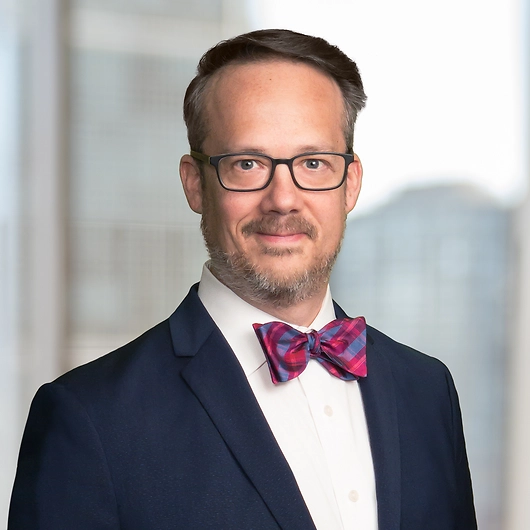
Adam S. Forman is an Epstein Becker Green attorney with a practice that sits at the intersection of employment litigation, traditional labor law, and workplace technology. In this one-on-one conversation with fellow Epstein Becker Green attorney George Whipple, Adam draws on decades of experience to explain why the legal questions around workplace technology are older than most employers realize—and why the stakes have never been higher.
What You'll Discover
- Why Operational Decisions Become Legal Problems: Adam explains how technology that seems like a straightforward business improvement can trigger wage, hours, and working conditions obligations that cut across the entire organization.
- Negotiating Technology in Unionized Workplaces: Employers have reached durable agreements with unions around emerging technology by being clear and specific about how those tools will and won't be used.
- A Bigger Toolbox for a Bigger Challenge: The legal frameworks for managing workplace technology are more familiar than employers think. Adam discusses what that means for employers navigating the complexity of artificial intelligence at work.
Transcript
[00:00:00] Adam S. Forman: I don't think the business unit was meaning to sidestep labor or legal. I just think they didn't know what they didn't know.
[INTRO GFX]
[00:00:12] George Whipple: I'm George Whipple, One-on-One with Adam Forman. Adam, thank you so much for joining us today.
[00:00:19] Adam S. Forman: It is my pleasure.
[00:00:21] George Whipple: I've always known you as a go-to guy on all things AI. Tell me a little bit about you and your practice.
[00:00:29] Adam S. Forman: I have somewhat of a traditional practice. I spend about a third of my time doing employment litigation.
[00:00:35] Adam S. Forman: That would be anything from a sex harassment lawsuit on a single plaintiff basis to a FLSA class and collective action in the wage and hour space. About a third of my time I spend doing traditional labor, so that would be bargaining at the collective bargaining table on behalf of an employer, litigating at the National Labor Relations Board. And the last third of my practice is really focused on the workplace technology, which over the last five to eight years has been a heavy emphasis on workplace artificial intelligence.
[00:01:05] George Whipple: Adam, do these things overlap? Do you find much use for your technology experience?
[00:01:11] Adam S. Forman: A lot of companies are set up and they're sort of siloed. The business units have their own autonomy to implement what they think is appropriate. So if you're someone who is trying to get product shipped quickly, and you go to a convention and you find out there is a lubricant that would make your conveyor belt go quicker, you're not going to check with labor relations or legal, likely, to find out if you should buy this.
[00:01:33] Adam S. Forman: The problem is when you start putting technology in to do that, that actually impacts wages, hours, and working conditions, now you have a worker issue.
[00:01:40] George Whipple: And you, in fact, had an issue like that with a client where they were using smart glasses in their warehouse.
[00:01:46] Adam S. Forman: The idea was that the workers who took packages and looked at the shipping label, it would tell them with a color-coding exactly where it was supposed to go.
[00:01:57] Adam S. Forman: Incredibly efficient and effective. I did work for the company, and I called up my in-house counterpart and I said, "This is so cool, and how did you get the union to agree to let their employees walk around all day with a camera recording everything?" And he said, "I'll call you back." In two hours he called me back.
[00:02:14] Adam S. Forman: Turns out that the business operations went and implemented it themselves because they figured it was an operational issue. Didn't even occur to them that there could be wages, hours, or working conditions impacted. They had something in the neighborhood of 50 grievances, six unfair labor practice charges to the board.
[00:02:31] Adam S. Forman: It was a huge mess, and I don't think the business unit was meaning to sidestep labor or legal. I just think they didn't know what they didn't know.
[00:02:41] George Whipple: So how would you handle a situation like that? I mean, how can you bargain with a union around these technologies that are moving so quickly?
[00:02:50] Adam S. Forman: So take a technology that's now pretty mature in American workplaces, global position satellite, or GPS.
[00:02:57] Adam S. Forman: A lot of employers that have mobile workforces have successfully implemented GPS on their vehicles in a unionized setting. One of the primary ways that happened with union agreement was an understanding of the limitations on how that tool will be used. We'll use it, for example, if you get in an auto accident to help protect you and demonstrate you didn't do it.
[00:03:20] Adam S. Forman: We'll use it for coaching and improvement on performing your duties. We will not use it to discipline you unless, for example, you're being dishonest, in which case we reserve the right to use it to demonstrate your dishonesty. Those are all issues that you would have to bargain with the union.
[00:03:37] George Whipple: Well, it's a pretty interesting niche. I mean, we're all talking about AI all the time. Have you always been interested in technology, or is this something that just came to you through work?
[00:03:48] Adam S. Forman: I've always enjoyed gadgets and technology. I was the kid who would have the Casio watch with the calculator on it.
[00:03:57] Adam S. Forman: The first Sony Watchman was in my arsenal. When I entered the practice of law, one of the partners indicated that a client was having a problem with the receptionist always playing the digital game Solitaire on their computer. That was a default game that was installed with all Windows 3.11 operating systems.
[00:04:18] Adam S. Forman: They wanted to know if they could monitor the worker, if there were privacy rights, if there were other issues that would lead them to legal liability if they did, and they asked who would be willing to take on the project. I quickly raised my hand, and from there I became the go-to associate for all workplace technology, so the internet, email, blogs, cell phones, cell phones with cameras.
[00:04:44] Adam S. Forman: It was simply a natural evolution to take those lessons learned and my substantive knowledge of labor and employment law and apply them to workplace artificial intelligence.
[00:04:55] George Whipple: So what do you say to an employer who's trying to navigate these issues, and they're all asking us all the time?
[00:05:03] Adam S. Forman: Social media, we thought, was really supercharged in the legal issues because it was broadcasting communications that were only happening in the workplace that potentially were problematic to the whole world.
[00:05:15] Adam S. Forman: AI has taken it to the next level, one that we never thought of. So the toolbox in terms of ways to approach these technologies, both in a beneficial way and a way to reduce risk, hasn't changed a lot. You just need a lot bigger tools.
[00:05:32] George Whipple: Adam, thank you very much for being here.
[00:05:34] Adam S. Forman: George, thank you so much for your time and for having me here today.
[00:05:37] George Whipple: And thank you very much for watching.
More Like This
- EventsABA 20th Annual Labor & Employment Law Conference2 minute read
 Videos & Podcasts
- Videos & Podcasts


People
 Member of the Firm
 Board of Directors / Member of the Firm